TRINAX
2021
Singapore Mobility Gallery By LTA
Designed the UI and interaction flows for two educational exhibits commissioned by the Land Transport Authority (LTA), encouraging children to understand how everyday choices contribute towards a greener future through interactive gameplay.

The Challenge
Something different - Designing for Children
The exhibit was designed for children under nine years old, requiring interfaces that could be understood almost immediately with minimal supervision.
Both experiences needed to balance three key objectives:
Teach sustainability concepts through play.
Keep interactions simple and engaging for young children.
Fit within the client's target interaction time while working within the constraints of custom exhibit hardware.
Unlike conventional digital products, users would only experience the installation once, making clarity and immediate comprehension critical.
Design Approach
Clearing biases and buckling down on simplicity
Three design principles guided the project:
Learn Through Play
Educational content should feel like a game rather than a lesson.
Clarity First
Instructions and feedback needed to be understandable within seconds by young children.
Keep Momentum
Interactions should maintain engagement while allowing visitors to progress naturally through the exhibit.
Decision | Reason |
|---|---|
Large team colours | Children could quickly recognise their team from a distance. |
Teleprompter-style scoreboards | Made scores readable while participants were moving. |
Large typography | Improved readability in a busy exhibition environment. |
Limited answer options | Reduced cognitive load for younger audiences. |
Visual instructions | Minimised reliance on reading ability. |
Edge-case messaging | Helped users recover quickly from sensor or interaction issues. |
Experience 01
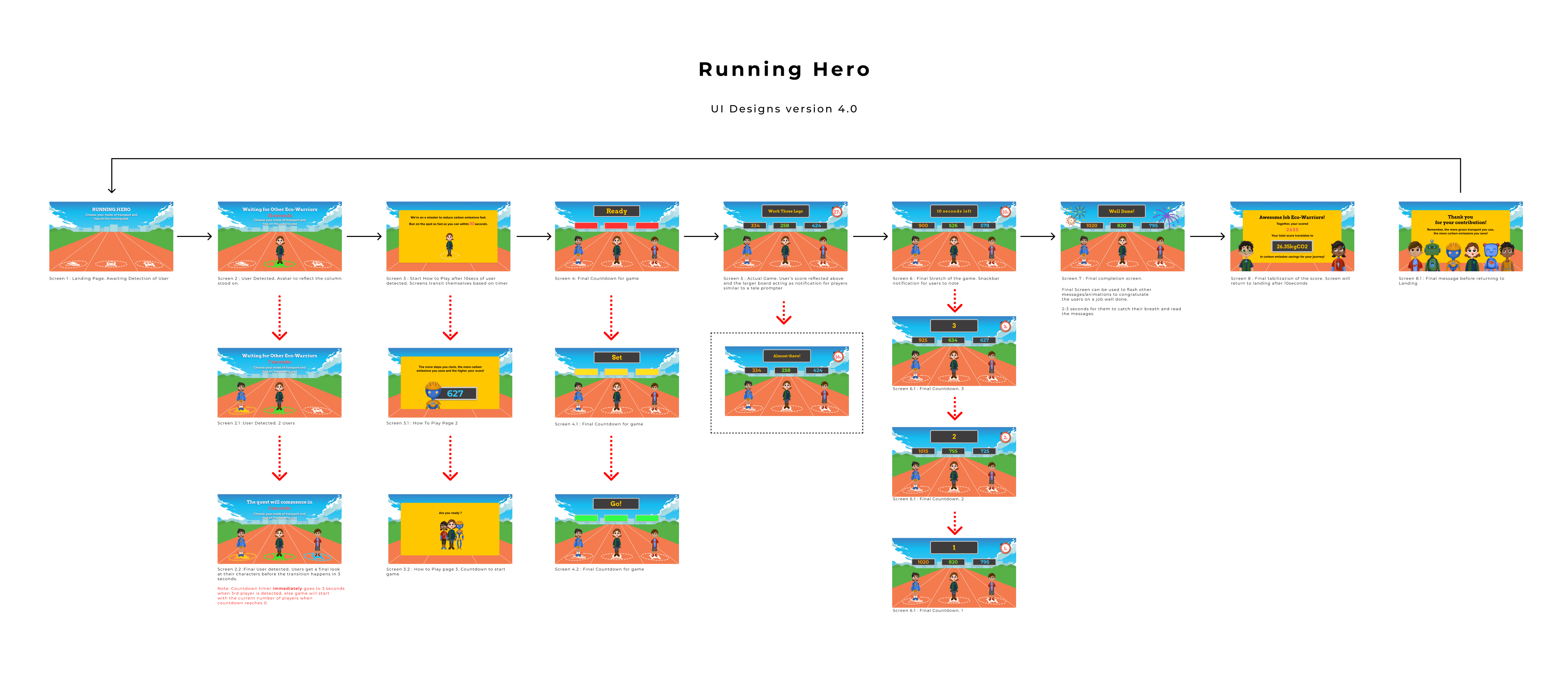
Running Hero Step Count Station
Objective

Encourage physical activity by allowing children to compete through a step-counting challenge while reinforcing the campaign's sustainability message.
Design Considerations
Large typography for distant viewing.
Distinct team colours for instant recognition.
Clear before / during / after gameplay states.
Real-time score feedback.
Visual prompts to encourage continuous movement.
Consistency with the campaign's established art direction.

Main Game Page
The interaction flow accounted for situations such as delayed sensor detection, inactive players, gameplay interruptions, and score updates to ensure users always understood the current state of the experience.
Experience 02
Eco Quiz
Objective
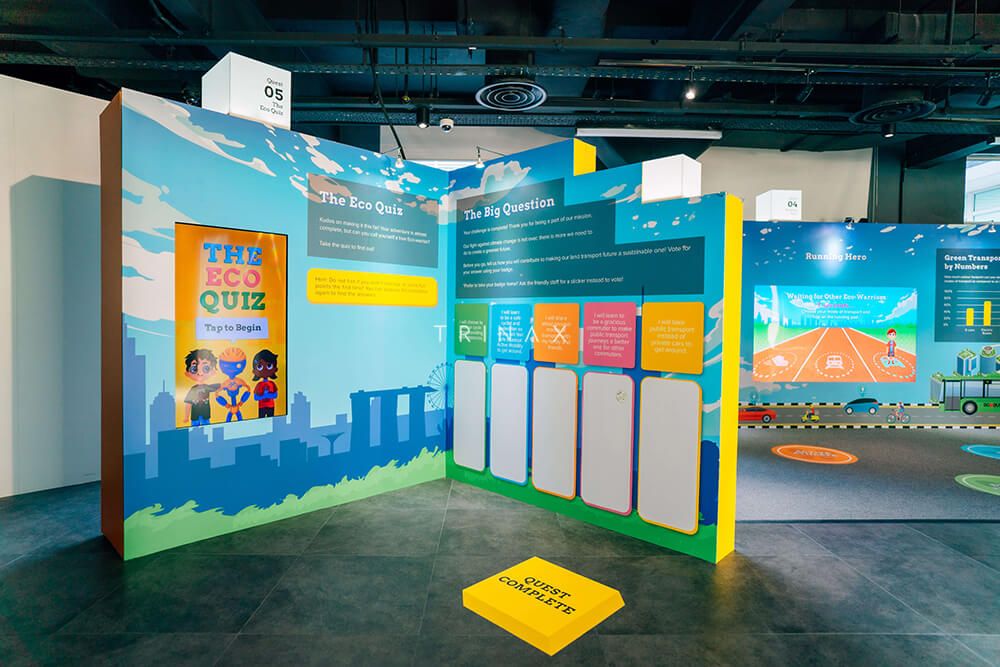
Create a short touchscreen quiz that reinforced sustainability concepts without overwhelming younger audiences.
Design Considerations
Simple question layouts.
Large touch targets.
Limited on-screen choices.
Clear progression between questions.
Avatar and team selection to create a sense of ownership and engagement.
Constraints
Audience
Children under nine required much simpler information architecture than a typical digital product.
Hardware
Layouts needed to conform to custom exhibit displays and interaction specifications provided by the hardware team.
Session Duration
The experience needed to remain engaging while fitting within the client's desired throughput for museum visitors.
Reflection
Designing for younger audiences reinforced the importance of clarity over complexity. Every interaction, animation, and piece of instructional content needed to communicate its purpose immediately, leaving little room for ambiguity. The project also strengthened my understanding of designing beyond the screen; considering physical context, interaction time, and user behaviour as equally important parts of the overall experience.